The Neapolitan agency that publishes its fee, its payment schedule and its commission policy, and designs the room before it dresses the table.
By The LWD Edit · 28 August 2026 · 5 min
Scroll
There is a page on Ester Chianelli Weddings & Events that no other planner in this batch of eight has an equivalent for. It is an FAQ, it sits on her About page, and it publishes, in order and without hedging: the pricing model, the total budget she recommends, the payment schedule, the cancellation policy, the annual capacity, the vendor selection standard and the commission policy. Ten per cent of the total wedding budget. From 1,200 euro per guest for the wedding itself, inclusive of all services. Forty per cent on signature, sixty per cent plus any budget increase thirty days before the date. Fees already paid are non-refundable on cancellation, for any reason. Fifteen couples a year. And no commission accepted from suppliers, ever, with discounts negotiated for the couple instead.
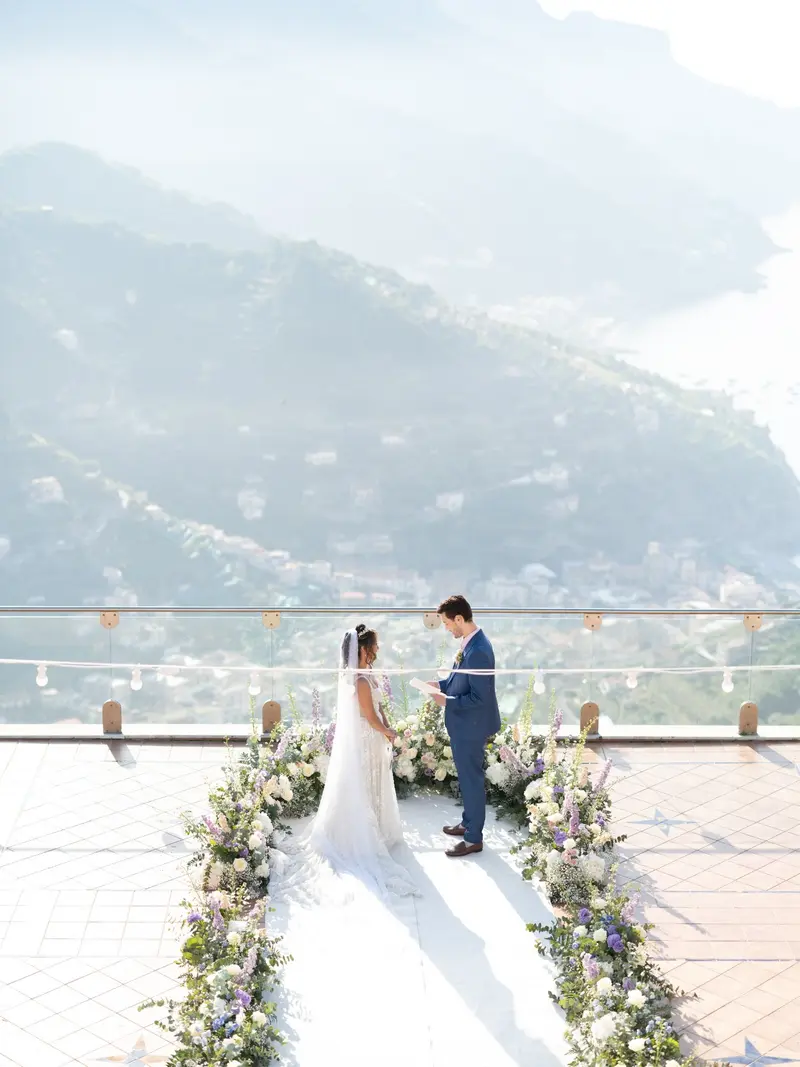
Guests seated for the ceremony under ruined arches, the town below
That last line deserves its own paragraph, because supplier commission is the structural conflict of interest built into this profession and almost nobody names it in public. A planner who takes ten per cent from the florist has a reason to recommend that florist. A planner who takes ten per cent from the couple has a reason to get the florist's price down. Ester Chianelli has written down which of those two she is, on a page a stranger can read before making contact.
She was going to be a marine biologist. Born in Naples in 1982, she took the degree and then spent a period as a television correspondent, travelling through more than thirty countries and filling, in her own phrase, her luggage with the customs of every part of the globe. She left the science at twenty three. The television years are the useful part of the biography, because they explain the two things the work is actually good at: a running order, and finding out what a place is really like before deciding what to do with it.
What she is known for is spatial design, and the distinction between designing a space and decorating one is the whole argument. Look at a marquee she has dressed: the citrus and greenery garlands are not draped along the poles, they are used to describe the shape of the ceiling, so a white tent stops reading as a tent. Look at a courtyard covered by pink silk pulled between palm trees with chandeliers hung inside it. There was no room there that morning. She built one, lit it, and only then put a table in it. The flowers are the last decision rather than the first, and a portfolio built that way looks different in every location instead of looking like the same wedding relocated.
The map is ten destinations and she publishes every one: the Amalfi Coast, Lake Como, Tuscany, Umbria, Lake Maggiore, Sicily, Puglia, Rome, Lake Garda and Venice. Unusually, she also publishes the venues. Her Amalfi Coast page names Villa Cimbrone, Palazzo Avino, Belmond Caruso and Villa Eva in Ravello, Villa Santa Caterina and the Grand Hotel Convento in Amalfi, and Villa Olivero, Villa Marincanto and Villa Treville in Positano, together with what to do with the guests between events: a yacht to Capri, a private tour of the lemon groves, a sunset cruise, a beach club taken over for the night before.
The terrace at night, round tables and the sea beyond the parapet
Campania is the home ground and it shows in the frames that would be hardest to buy. Dinner laid along a wooden deck at the water with a castle standing offshore behind it, the tables running to the edge of the boards. The same deck at sunset with the guests seated and the castle gone to silhouette. Fireworks over a whole bay at the end of the night, the town lit along the waterline. Those are permits, harbour relationships and a supplier who will bring a rig out on a Saturday in August, which is a different asset from taste.
Puglia is where the work looks most confident, and it looks confident because there is less of it. An olive grove strung with festoon lights and laid for a hundred, the trees doing the architecture. A palace with battlements across a lawn planted with palms, round tables under the pines. Green and white patterned ceramics, limes on the linen, calla lilies and anthuriums in low glass, a gilt-edged plate with a dark green velvet bow on it and nothing else. Southern Italian materials used as design rather than borrowed as a theme.
A gilt-edged plate, a dark green velvet bow, taralli
A place setting in blush: pink tapers, garden roses, gold cutlery
North of all that the register changes completely, and she works it anyway. Lake Como, Lake Garda and Lake Maggiore, where the water is cold and the boats are mahogany and a couple crossing from one shore to another arrives at their own reception. Venice, where the logistics are a different discipline again because everything moves by water or by hand. Rome, Tuscany and Umbria in the middle of the country, and Sicily at the far end of it. Ten regions worked from one studio in Naples, by a team that travels, rather than by a network of local franchises operating under one name. That is a harder business to run and a much easier one to be a client of, because the people who designed your wedding are the people who turn up to direct it.
On suppliers she is exacting in a way that is worth reading closely. Over the years, she writes, the agency has worked with hundreds of venues and suppliers and built partnerships with the ones that met its standards, and the network is made of artisans who treat each wedding as a single commission rather than a repeat order. Couples come to her, she says, because of the images and the films of the weddings she has planned, and that level of quality is only achievable when everyone involved is working to the same standard. She is open to new collaborators who reflect the same professionalism. She will also tell you, during planning rather than at the end, if a particular supplier brings additional fees because the logistics are complicated. Both positions are on the same page as the commission policy, and they are consistent with it.
The process itself is published in seven numbered steps, which is another thing most agencies keep back. Ideation: a call to establish the vision and the style. The wedding lookbook: digital sketches drawn in Procreate or handmade watercolours, delivered before anything else, which is a slower and much more revealing document than a shared board of other people's weddings. Design refinement, detail by detail. Communication, through Google Workspace, so the budget is visible rather than reported. Vendor management, with her team speaking directly to suppliers as the date approaches. Day-of coordination against a written timeline covering everyone from the caterers to the clean-up crew. And adaptability, listed as a step rather than as reassurance, with contingency plans held for the weather.
Alongside it runs the Wedding Concierge, which is the part international couples underrate until the week arrives. A member of her team becomes the point of contact for every guest: transport to and from the venue, welcome packages, restaurant reservations made by telephone in Italian because many places in Italy still take bookings no other way, local recommendations, an on-site concierge on the day, and a wedding website her team builds and keeps updated. For a couple whose families are arriving from three time zones without the language, that is not a luxury, it is the difference between a week that works and forty separate WhatsApp threads.
Cutting the cake on a balustrade above the sea
The evidence outside her own site is consistent. RSVP Club named her Best Wedding Planner in 2025. Weddings by her team have appeared in Elle, Style Me Pretty and Destination I Do. Her Google Business Profile carries a 5.0 average across sixteen reviews, and she replies to them at length and by name, which is a small thing that tells you how the practice is run. The mother of a groom wrote that the planning was precise, the attention to detail exquisite and the execution seamless, and that everyone who attended is still saying the bar has been set so high. A bride who had to pause her wedding for three years wrote that she was postpartum and nervous while planning and that Ester exceeded expectations anyway, and that her husband said he had never seen such a team.
Two names recur in those messages: hers and Alessandra's. Alessandra grew up in Caserta, took a law degree, came in as an intern and is now the right hand, running coordination beside her. Four people appear in the team photograph on the About page. That is the size of practice that fifteen couples a year is designed to protect, and the reason she gives for the limit is telling: not exclusivity, but room to build the events around the wedding as carefully as the wedding, the welcome dinners and the boat days and the farewell brunches.
A long table under the olives, festoon lights strung above it
So the fit is easy to describe. A couple marrying in Italy from somewhere else, who want the room designed rather than the table decorated, who would like the fee and the payment schedule and the commission policy in front of them before the first call rather than after the third, and who intend to bring people a long way and would rather those people had a week than an afternoon. Ask about the region first. There are ten of them, she publishes all ten, and she will tell you which one your wedding actually wants to be in.
The same deck at sunset, dinner served, the castle in silhouette
Credits
Planning and design
Ester Chianelli Weddings & Events
Written by
The LWD Edit
The editorial team at Luxury Wedding Directory, profiling the world's finest wedding venues and creatives.
Filed under
Share
Ester Chianelli Weddings & Events · Enquire
Enquire with Ester Chianelli Weddings & Events
Send an enquiry and our wedding team will connect you with the venue.
We use essential cookies to make our site work, and optional cookies to personalise content and improve your experience. By clicking Accept All, you agree to our use of cookies. · Cookie Policy